Notes/18 November 2026
Dry transfer vs vinyl label: which survives powder coat?
Film thickness, edges, clear coat and cost per part - a practical comparison for designers specifying markings on painted metal.
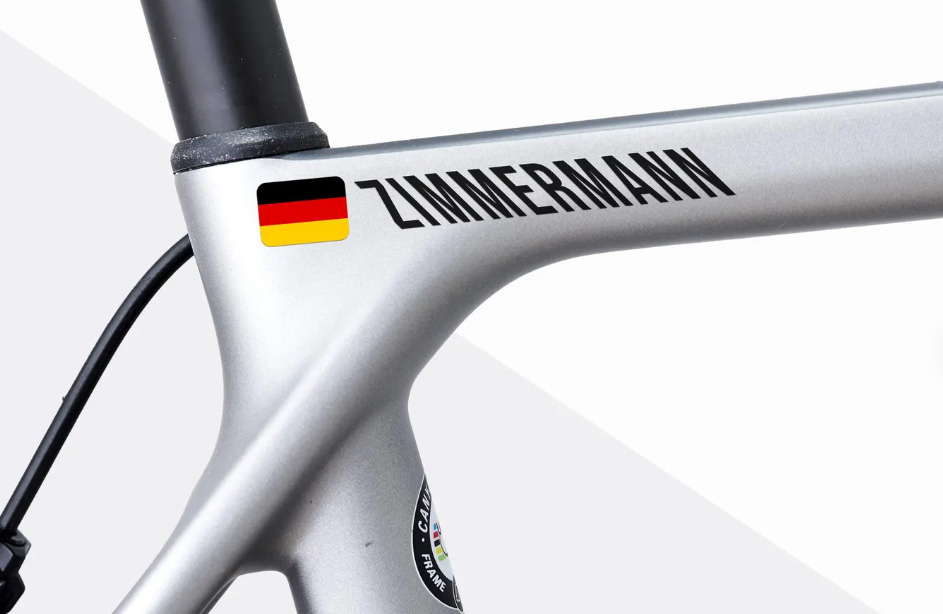
Both put a mark on a part. Only one leaves the part looking painted. The difference is not the printing - it is what stays behind after application.
What actually lands on the part
A vinyl label is a film: 50-100 µm of PVC or PU, an adhesive and a printed surface, all sitting on top of your paint. A dry transfer is ink only. It is printed on a carrier sheet, rubbed down and the carrier peeled away, leaving 3-8 µm of pigment bonded to the surface.
That single difference decides most of what follows: edges, clear coat, weathering and how the mark reads in raking light.
The edge is the failure point
Every sticker has an edge. On a powder-coated frame that edge collects dust, polish and road spray, and a pressure washer finds it. The film also expands and contracts at a different rate from the paint underneath, so the adhesive line starts to show.
A dry transfer has no edge to lift. Under a clear coat it is sealed in the same film as the paint, and the surface stays flat enough that a fingernail slides over it.
Clear coat changes the decision
If the part is lacquered after marking, vinyl is usually the wrong choice. The clear coat bridges the film edge, which looks acceptable for a season and then telegraphs as a ridge. A dry transfer disappears under the same coat.
If the part is never lacquered - a painted enclosure, a wooden box - both work. Vinyl is faster to apply; a dry transfer looks more like print.
Where vinyl still wins
Very large graphics, one-off or two-piece runs, and parts that are already finished and cannot be coated again. Vinyl also tolerates coarse texture better than a thin ink film.
Cost per part, not per sheet
A dry transfer sheet looks expensive next to a roll of vinyl - until the sheet is divided by the number of parts it covers. A4 holds dozens of small marks; a full frame set fits on A3. At 100-1,000 units the cost per part is usually below the labour of applying and trimming individual labels.
Setup is the plate and the adhesive screen, which is why the price falls quickly with quantity and why 100 sheets is a sensible minimum.
Test on your own part
Substrate, cure state and top coat decide the result, not a datasheet. Send a part or a coated panel and we return applied samples for your own adhesion, solvent and weathering tests before a production run.
Specifying a marking on metal or plastics? Tell us substrate, size and quantity.
Request a quote